
.NET Enterprise Application Development for Secure, Scalable, Business-Critical Systems
Enterprise applications built on the .NET ecosystem carry significant operational weight. They support core business processes, integrate across complex system environments, and must perform reliably as organizational demands grow. When they fall short — in performance, security, or adaptability — the impact extends beyond IT into business continuity and competitiveness. The challenge at enterprise scale is not building something that works today. It is building a system that continues to perform as transaction volumes increase, integration requirements expand, and organizational priorities shift. That requires architectural discipline from the outset.
 NDA ProtectedClient-Owned IPEnterprise ArchitectureNDA ProtectedClient-Owned IPEnterprise ArchitectureNDA ProtectedClient-Owned IPEnterprise Architecture

Built for enterprise IT leaders and architects managing mission-critical applications within the Microsoft ecosystem.

Challenges Enterprises Face with .NET Applications

Enterprise .NET systems require architectural discipline from the outset to remain viable as operational complexity increases.
Our .NET Enterprise Development Services
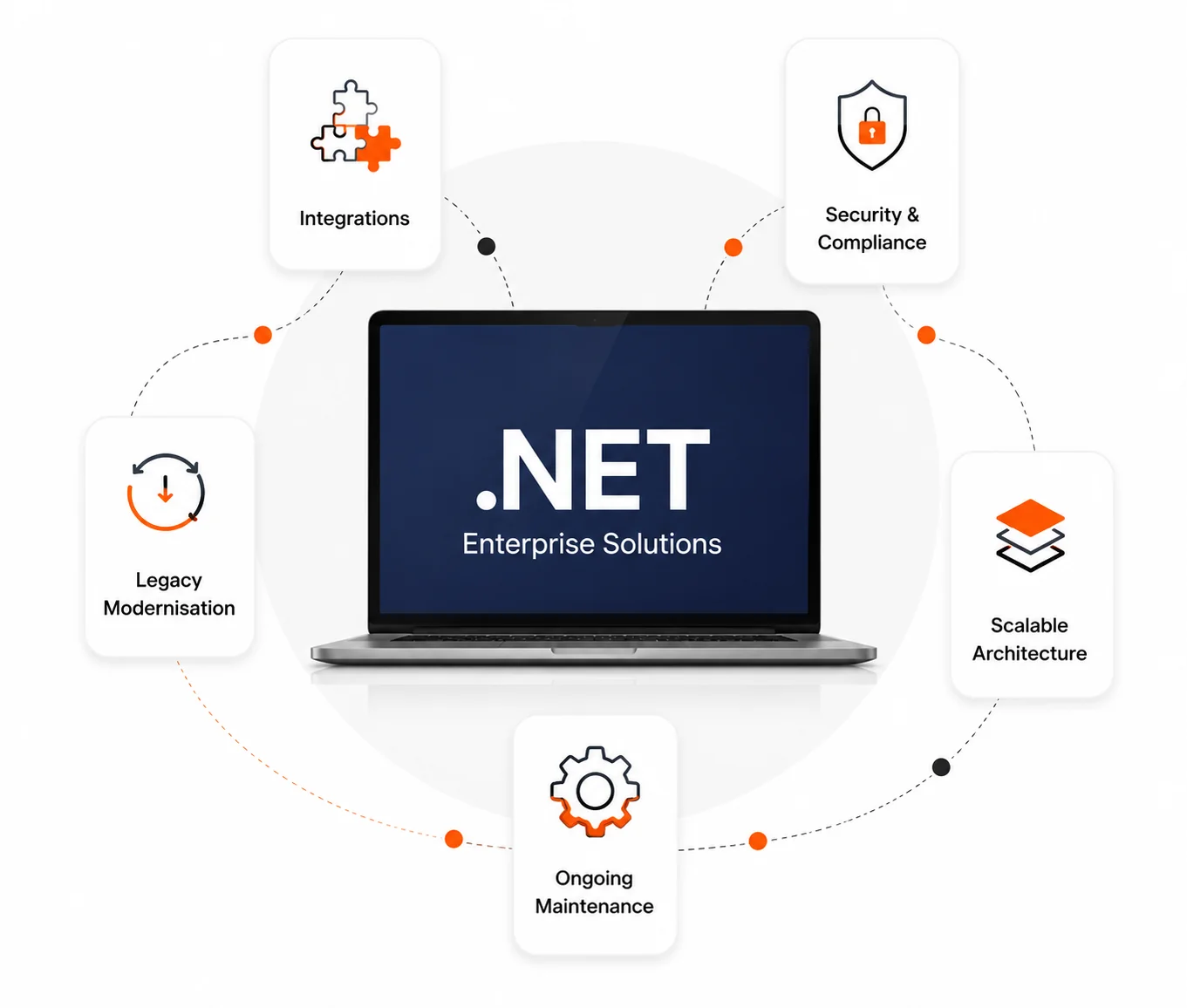
We deliver the full spectrum of .NET enterprise development services — from custom application builds and legacy modernization through integration work, performance optimization, and long-term maintenance.
Custom .NET Application Development
We design application architectures capable of handling expected transaction volumes, user concurrency, and data processing loads while maintaining performance under operational stress. Security is integrated throughout the development lifecycle, not applied at deployment. Architecture is designed to remain viable as operational complexity increases — not merely sufficient at launch.
Legacy .NET Modernisation
We assess existing architectures to identify structural constraints, then execute phased modernization that reduces technical debt while maintaining operational continuity. This includes upgrading deprecated frameworks, refactoring monolithic architectures, and implementing modern security standards.
System Integration
We design integration layers that connect .NET applications reliably with external APIs, cloud services, data platforms, and third-party systems. Integration architectures are built for resilience — ensuring that failures in connected systems do not cascade into core business applications.
Performance Optimisation and Refactoring
We analyze system behavior under realistic load conditions, implement targeted improvements, and validate that changes deliver measurable gains. Refactoring reduces accumulated maintenance overhead and improves the system's ability to absorb future changes without destabilization.
Ongoing .NET Maintenance
Structured patch management, dependency lifecycle control, performance monitoring, and incremental architectural improvements ensure .NET systems remain secure and stable as both the business and technology environments around them change.
For organisations that need to scale their .NET development capacity, we also provide the option to hire .NET developers who bring enterprise-grade engineering capability to your existing teams.
When to Choose .NET Enterprise Development
When .NET Becomes the Right Enterprise Technology Choice
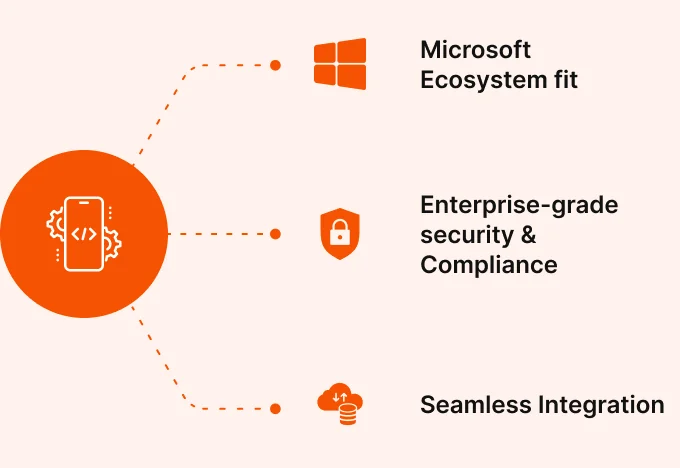
.NET is the correct choice when your organisation operates within the Microsoft ecosystem, requires enterprise-grade security and compliance capabilities, and needs applications that integrate reliably with Azure services, SQL Server, and existing Microsoft infrastructure. It is the right path for mission-critical systems where stability, vendor support longevity, and structured governance are non-negotiable.
When Alternative Frameworks May Be More Suitable
.NET is not the right choice when the application does not require enterprise-level infrastructure, when the team's expertise and existing stack are built around a different ecosystem, or when the project's requirements are better served by lightweight frameworks with faster iteration cycles. The decision should be driven by integration context and operational requirements — not by familiarity with the platform.
Consulting-Led .NET Development Approach
Delivering enterprise .NET systems that remain reliable over time requires disciplined architectural planning and structured risk management — not just development capacity.
Requirements Analysis and Architecture Planning
Before development starts, we work to understand the operational context, integration dependencies, security requirements, and performance expectations that will determine whether the system delivers value. That clarity shapes every architectural decision and reduces the likelihood of costly course corrections once development is underway.
Governance, Quality, and Validation
Code quality standards are enforced, security practices are validated, and architectural decisions are documented throughout delivery. Testing occurs continuously rather than as a final phase, reducing rework and ensuring quality is maintained from development through to production.
Post-Deployment Support and Knowledge Transfer
We provide documentation, knowledge transfer, and ongoing technical guidance that enables internal teams to maintain and extend applications without dependency on external resources for routine operations.
Requirements Analysis and Architecture Planning
Before development starts, we work to understand the operational context, integration dependencies, security requirements, and performance expectations that will determine whether the system delivers value. That clarity shapes every architectural decision and reduces the likelihood of costly course corrections once development is underway.
Governance, Quality, and Validation
Code quality standards are enforced, security practices are validated, and architectural decisions are documented throughout delivery. Testing occurs continuously rather than as a final phase, reducing rework and ensuring quality is maintained from development through to production.
Post-Deployment Support and Knowledge Transfer
We provide documentation, knowledge transfer, and ongoing technical guidance that enables internal teams to maintain and extend applications without dependency on external resources for routine operations.


Engagement Models We Offer
We structure engagements to align with how product teams plan, budget, and scale .NET enterprise applications over time.

Dedicated .NET Developers
For projects with evolving requirements that cannot be fully defined upfront, dedicated .NET developers provide the continuity and deep system familiarity that rotating teams cannot. This model is the right fit when the .NET environment's complexity directly affects the quality of architectural decisions, when knowledge loss between phases would create measurable risk, and when sustained delivery capacity produces better outcomes than periodic project engagements. Developers operate as an extension of your technology team, building context over time that directly improves delivery quality and decision speed.
Best For: Complex .NET environments requiring sustained team involvement and deep system familiarity.

Project-Based Development
When scope is clearly defined, timelines are fixed, and the objective is a specific application build, legacy modernisation, or integration implementation, project-based development delivers predictable outcomes against agreed milestones. This model works when requirements are bounded, the deliverable is specific, and the team does not need ongoing .NET support beyond the project.
Best For: Specific builds, modernisation, or integrations with clearly defined scope and fixed timelines.

Consulting & Advisory Engagement
When the modernisation path is uncertain, or when teams need to evaluate .NET architecture options before committing development resources, a consulting engagement provides the evaluation framework to make that call with confidence. This model covers architecture assessment, framework version evaluation, and migration planning — helping organisations avoid committing to a technical direction before the requirements justify it.
Best For: Architecture assessment, framework evaluation, and migration planning before committing resources.

Flexible Engagement Approach
Not every .NET initiative follows a predictable trajectory. A modernisation project may reveal the need for ongoing maintenance, or a bounded integration effort may expand as dependencies surface. We structure engagements to accommodate that shift without requiring new vendor relationships, knowledge transfer, or re-onboarding — allowing teams to move between delivery models without losing momentum or architectural context.
Best For: .NET initiatives where scope may evolve or expand during delivery.
Technologies and Platforms Within the .NET Ecosystem
We work across the Microsoft technology stack — .NET Framework, .NET Core, ASP.NET, Azure services, SQL Server, and related enterprise platforms. Technology selections are driven by organizational requirements, existing infrastructure investments, and long-term supportability.

Cloud and Hybrid Deployment
Whether deploying to Azure, on-premise infrastructure, or hybrid environments, we ensure systems integrate reliably, maintain security standards, and support operational requirements. Deployment architecture is aligned with enterprise IT strategy, not chosen for development convenience.

Long-Term Platform Viability
The objective is a system that can be maintained, extended, and operated reliably as the business grows — without unnecessary platform dependency or short-term architectural compromise that creates migration pressure two years after launch.

Why Choose NebulaTech for .NET Enterprise Development
Our consulting-first approach ensures that .NET systems are designed around business requirements rather than technical preferences.
The difference is not in development capability alone, but in how decisions are structured before development begins.
NDA-First Engagement and Client Ownership


NDA-first engagement protects proprietary business logic, competitive strategies, and sensitive operational details. All code, architectural documentation, and intellectual property produced during the engagement is fully owned by the client.
Security and Compliance by Design
Architectures for Scale and Longevity
NDA-First Engagement
and Client Ownership
Security and Compliance
by Design
Architectures for Scale
and Longevity
NDA-first engagement protects proprietary business logic, competitive strategies, and sensitive operational details. All code, architectural documentation, and intellectual property produced during the engagement is fully owned by the client.
Cost of .NET Enterprise Development
What Determines .NET Enterprise Development Cost
The cost of .NET enterprise development is shaped by application complexity, the scale of integration requirements, security and compliance obligations, and whether the engagement involves new development, legacy modernisation, or ongoing maintenance. A targeted workflow application serving a single department carries a different investment profile than a multi-system platform with complex data governance, cross-functional integration, and regulatory compliance across multiple jurisdictions.
Key Factors Influencing Total Investment

Legacy .NET Involvement
Existing .NET architecture, integrations, and legacy components directly impact modernization complexity and investment.

Framework Version Migration
Migrating to newer .NET versions requires compatibility analysis, testing, and structured upgrade planning.

Monolith Refactoring
Breaking large monolithic systems into maintainable modules increases engineering effort and implementation scope.

Deprecated Dependency Management
Replacing unsupported libraries and outdated third-party dependencies adds development and testing complexity.

Technical Scope & Business Requirements
Feature requirements, integrations, workflows, and operational needs directly influence total development investment.

Detailed Cost Visibility
Transparent estimates based on clearly defined scope help organisations evaluate investment against measurable deliverables.